When Your Structure Speaks
Every box and line on your organisation chart tells a story about agility, control, and the invisible pulse of your business.
It’s more than a static diagram of names and titles. It’s the X-ray of how your company truly operates.
If your organisation chart could talk freely, what would it say?
Would it speak of cross-functional collaboration and empowered teams, or whisper about silos, slow approvals, and unclear ownership?
Most leaders think of their org chart as a reporting formality. In reality, it’s a living ecosystem, a mirror reflecting how people, processes, and platforms move together (or don’t).
Your chart is already telling you whether your business is built for adaptability, whether decisions travel fast, and whether innovation finds open doors or dead ends.
The Silent Signals in Every Organisation Chart
Think of your chart as a living pulse map. When lines are short and connections close, information moves freely, decisions are made faster, trust replaces control, and innovation flows upward as naturally as it flows down. But when layers pile up, when teams are buried under approvals or boxed off by hierarchy, the signal weakens. Energy that could drive transformation gets trapped in process friction.
- Dense structures often point to slower responses and dependency loops.
- Flat structures may seem modern, but can hide chaos when visibility is weak.
- Missing or duplicated roles signal blurred accountability.
These patterns are rarely accidental; they’re reflections of how an organisation has grown, what it values, and what it fears. And this is precisely where platforms like Workday step in as a dashboard and a lens.
Through its analytics, you can uncover how your organisation really operates beyond the chart. You start to see:
- where collaboration peaks,
- where capability gaps emerge, and
- where alignment quietly breaks down.
It’s like translating your structure into a language of readiness. Because the truth is, your organisation has been whispering clues all along, you just need the right tools to listen.
What a Digitally Ready Organisation Looks Like
A digitally ready organisation moves with intention evolving its systems, people, and decisions in sync. In these organisations, data becomes dialogue.
Decisions no longer wait for approval ladders; they travel along trust lines built by transparency. Teams form and reform around outcomes and processes. Planning connects seamlessly between HR, Finance, and Operations, creating a single rhythm of direction rather than three competing beats.
In such ecosystems, Workday acts like connective tissue, uniting visibility across functions, integrating insights from workforce analytics, financial forecasting, and operational planning into one continuous stream of intelligence.
The result? Transformation stops being a project and starts being a habit.
Leaders no longer “react” to change, they navigate it with confidence, backed by data that reveals where to pivot, where to invest, and where to simplify.
Because digital readiness is not about keeping pace with technology, it’s about ensuring technology moves at the pace of your people.
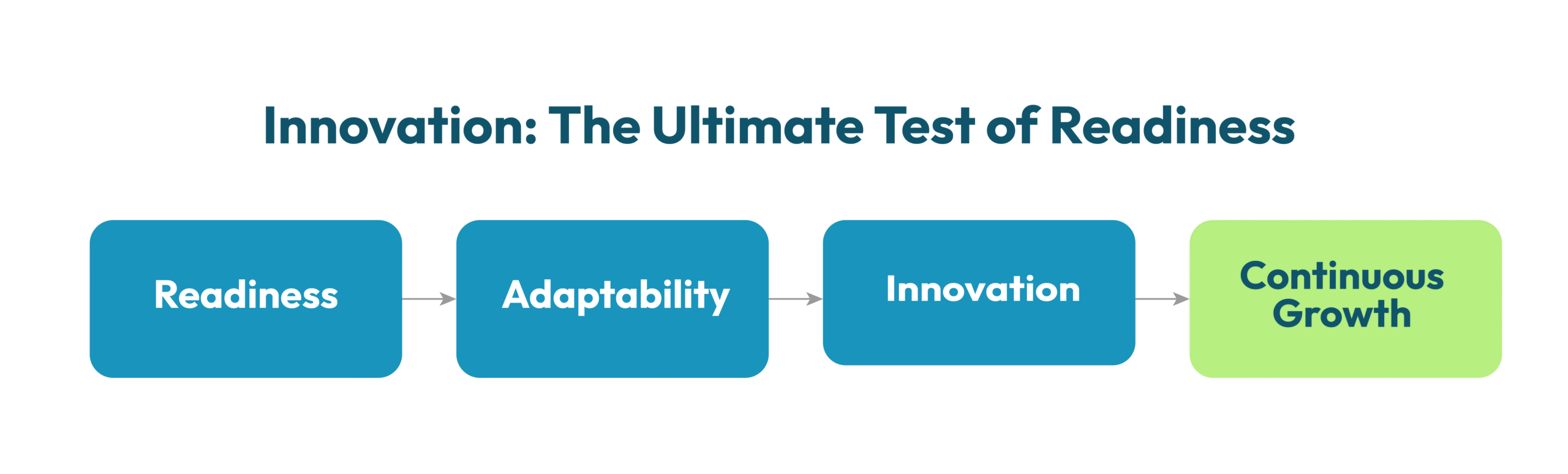
Innovation: The Ultimate Test of Readiness
Technology can power progress, but only people can spark innovation.
In digitally ready organisations, curiosity moves freely, across roles, levels, and functions, shaping how people think, plan, and build for what’s next.
That’s what separates organisations that survive disruption from those that define it. Readiness shows itself not in reaction, but in creation.
Digitally mature companies share three traits:
- They empower curiosity at every level.
Experimentation thrives when it stops being an exception and starts being how progress happens. - They use data to test, not just to track.
Predictive insights and scenario planning tools, like those in Workday, let leaders simulate outcomes before committing to decisions. - They view change as iteration, not interruption.
Every adjustment to process, product, or team feeds a loop of continuous improvement.
Workday fuels this cycle through dynamic workforce planning and predictive analytics, enabling teams to not only respond to shifts but anticipate them.
When people understand how their roles connect to impact, ideas gain momentum. And when systems support flexible collaboration, those ideas take shape faster.

These aren’t stages; they’re a cycle. One flows into the next, creating a culture of continuous improvement. Because the true measure of readiness is the ability to sustain progress.
From Structure to Strategy: Building Continuous Readiness
Every Workday-enabled digital transformation framework begins the same way: with clarity. Not clarity of goals, but clarity of structure.
You can’t scale change until you understand how your organisation holds together.
That’s why readiness is less about acceleration and more about awareness.
To build continuous readiness, the kind that fuels growth, not just survival, leaders need to anchor transformation in three core principles:
- Visibility before velocity.
Before you move faster, see deeper.
Map your structure, understand its strengths and bottlenecks, and align every change to that understanding. - Empowerment over control.
Real agility doesn’t come from adding layers of oversight. It comes from giving teams access to real-time insights and the autonomy to act on them. - Iteration over completion.
Transformation is the rhythm that keeps an organisation evolving. The organisations that thrive are those that treat readiness as a continuous feedback loop, always sensing, learning, and adapting.
With our Reporting, Analytics and Planning solutions, that loop becomes tangible. We connect insights across HR, Finance, and Operations, creating a living dashboard of organisational intelligence.
Leaders can see, in real time, how strategy translates into structure, and how structure enables strategy.
When your people, systems, and structure evolve in unison, transformation stops being an event. It becomes your operating rhythm. And that’s when readiness turns into resilience, and resilience turns into leadership.
Your organisation chart has been speaking all along. It’s time to stop reading it as a diagram and start hearing it as a dialogue.
Turn your structure into your strongest signal of readiness. Discover what your organisation chart has been saying all along.