Planning a Workday implementation often starts with one question: How long will it take?
The answer depends on several factors, but every successful project follows a structured path. From defining business requirements and designing future processes to testing, deployment and post-go-live support, each phase builds on the last and plays an important role in delivering long-term value.
Although Workday project timelines generally follow a familiar framework, every organisation’s journey is unique. Project scope, business priorities, integrations, data quality and rollout strategy all influence how the timeline unfolds. Understanding these phases before the project begins makes it easier to plan resources, manage expectations, and keep delivery moving forward.
In this article we’ll cover:
- How long a typical Workday project takes
- Why timelines vary between organisations
- What happens during each project phase
- Practical ways to keep your implementation on schedule
Workday Implementation Timeline: What to Expect at Every Stage
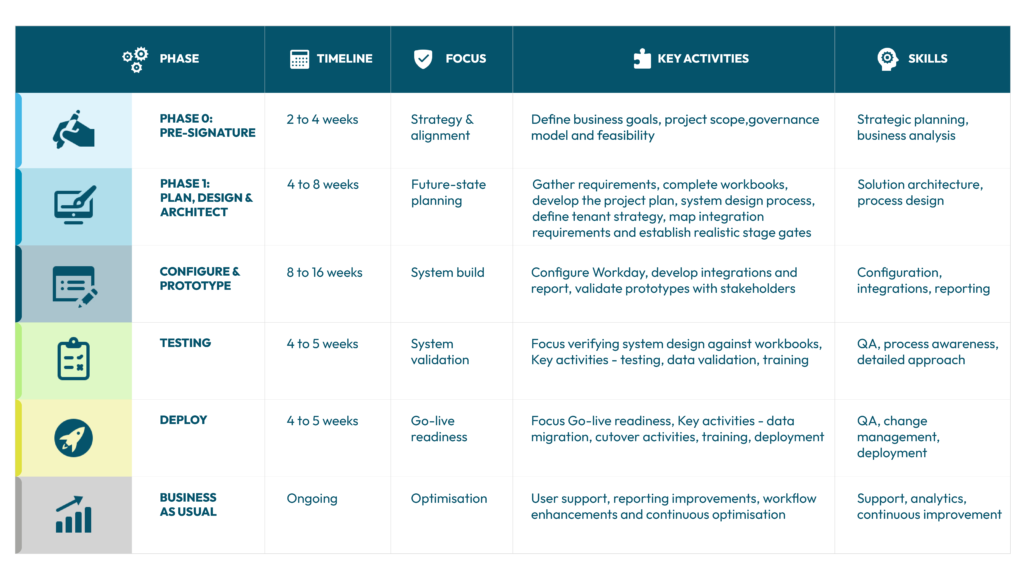
The Workday project lifecycle is made up of a series of interconnected phases. Each phase has its own goals, deliverables and stakeholders to set the stage for the next phase.
Instead of seeing implementation as one big project, it is helpful to see it as a journey that goes from planning and design through configuration, testing, deployment and continuous improvement.
And if you know that structure, you can plan resources, manage expectations and get your teams ready for what’s coming.
How Long Does a Typical Workday Project Take?
There isn’t a universally applicable timeline for organisations.
A smaller implementation with a few modules may take four to six months, while a large enterprise rollout across several business units, countries or functions can take nine months or even more.
These are illustrative timeframes and not fixed targets. The length of a Workday implementation timeline will vary depending on the scope of the project, the complexity of the organisation and the level of preparation before the project starts.
Each phase of the project builds on the previous one. Configuration is affected by decisions made at planning time. Testing is a validation of those decisions. Deployment depends on the quality of everything done before. Giving each phase the attention it deserves reduces rework later in the project.
Why Do Some Workday Projects Take Longer Than Others?
Even organisations implementing the same Workday modules can have very different timelines.
Several factors influence the pace of delivery:
- Number of Workday modules being implemented, such as HCM or Finance. Payroll.
- Data quality, including duplicate records, missing information or inconsistent data that needs cleansing before migration.
- Integrations with existing enterprise systems, third-party applications, and reporting platforms.
- Global versus local rollouts, where multiple countries introduce additional compliance, localisation and stakeholder requirements.
- Business process complexity, particularly when existing processes require significant redesign.
- Configuration choices, as organisations tailor Workday to support their operating model while keeping future maintenance manageable.
Projects also tend to move more smoothly when decision-makers are readily available. Delays in approvals, changing requirements or unclear ownership can slow progress across multiple stages of the project.
Keeping Your Project on Schedule
Everyone wants to see an efficient implementation, but the most successful projects are focused on preparation, not on speed.
A few practical habits can make a significant difference:
- Define project scope before implementation begins.
- Cleanse and prepare data early instead of waiting until migration.
- Start integration planning as early as possible to avoid downstream delays.
- Keep customisations focused on genuine business requirements.
- Assign decision-makers who can review and approve changes quickly.
- Bring experienced project resources into the programme from the outset.
- Include testing, training, and change management in the project plan from day one.
Good planning offers chances to improve delivery without adding risk. Meanwhile, cutting back on key activities such as testing, user training, or data validation can result in problems that will be much more difficult to fix after go-live.
For a deeper look at project planning and delivery best practices, explore our Workday Manager’s Playbook.
Conclusion
All Workday projects follow a structured lifecycle, but the timeline will vary depending on your organisation’s goals, complexity and readiness. Understanding what each phase includes helps you plan resources, manage expectations, and make informed decisions throughout the project.
With the right expertise at every stage, your team can keep the project on track and build a strong foundation for long-term success.
Ready to move your Workday project forward?